AI can run your Google Ads. It can't see where your money leaks.
AI can set up and tweak a campaign. It can't see the enquiry that waited a day for a call back.
I was reading a thread on Reddit the other day. A marketer was asking which skills will still matter once AI can run most campaigns. The research, the ads, the setup, the tweaking. All of it is heading towards automation.
One reply stuck with me. It went something like this: the ads can be fine, and a clinic still takes a day to ring people back, so the campaign "fails". Knowing where the money actually leaks in a business is a lot harder to automate than running the ads.
I couldn't agree more.
AI already runs a lot of your account
Google has been automating Google Ads for years. It sets your bids. It writes ad variations. Performance Max decides where your ads show and who sees them. And now there are AI tools that will research competitors, write the ads and build the whole campaign for you.
Some of that is genuinely useful. But all of it stops in the same place: the moment someone clicks, calls or fills in a form.
What Google can't see
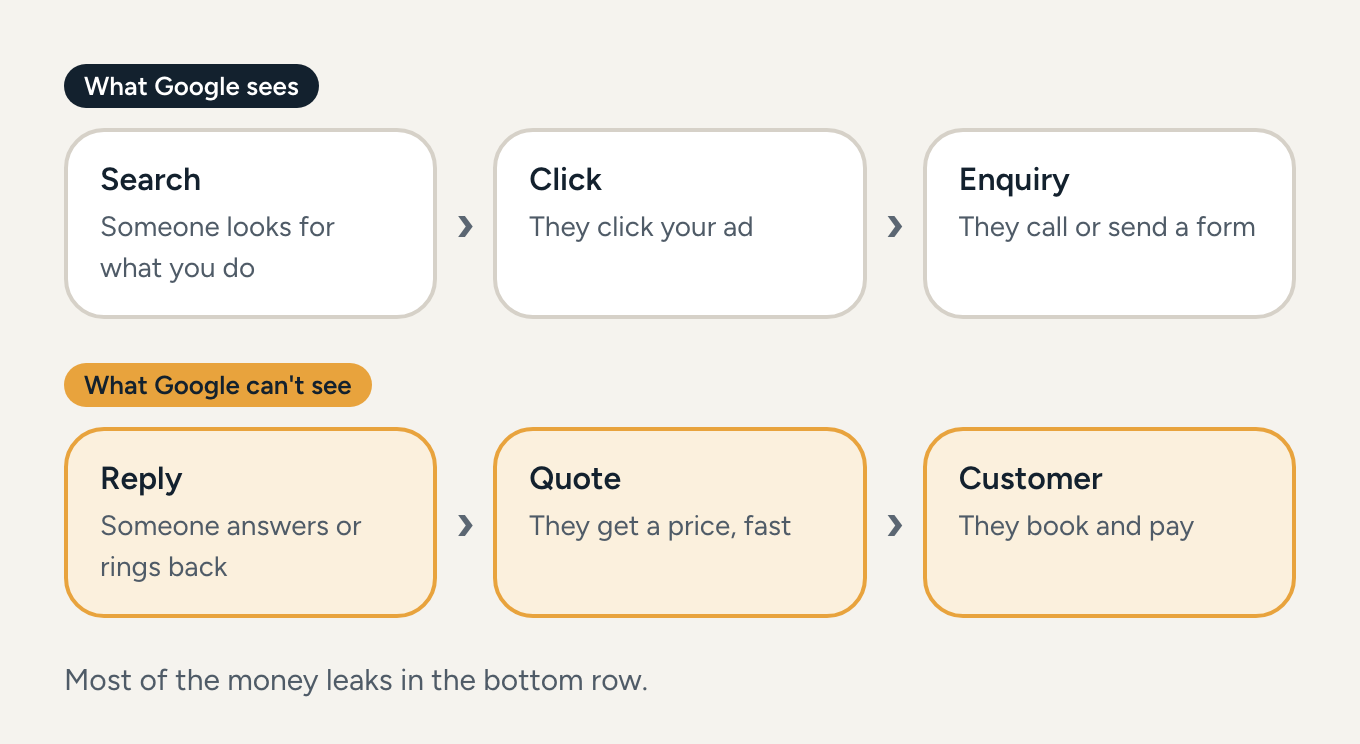
Google sees a click. It sees a call that lasted more than a minute, or a form that was sent. It counts a conversion and moves on.
It doesn't see:
- the phone ringing out because you were on a job
- the form sitting in an inbox until tomorrow
- the quote that went out a week late
- the enquiry from 40 miles outside your area
- the person who wanted it done for half your price
- the customer who booked and never turned up
Every one of those is a leak. And none of them show up in your Google Ads account.
And the campaign gets the blame
Take a clinic. The ads are fine. They show for the right searches and the enquiries come in at a sensible cost. But nobody rings them back until the next day. By then, half of them have booked with the clinic that called in ten minutes.
The owner looks at the bookings, sees not much, and decides Google Ads doesn't work.
An AI tool looking at that account would say everything's fine. It might even suggest raising the budget. More enquiries, into the same leaky bucket.
It can make the leak worse
Google's automated bidding learns from whatever you tell it counts as a conversion. If every form counts the same, whether it's spam, a time-waster or a real customer, it will happily find you more of whatever's cheapest. That's rarely customers.
AI is very good at hitting the target you give it. It can't tell you the target is wrong. (More on this in Google says you got 40 conversions. Your phone says otherwise.)
Where a person still earns their money
None of this is about tools. It's about understanding how your business actually makes money:
- what a customer is worth to you, so you know what you can afford to pay for an enquiry (the numbers have to add up)
- who answers the phone, and how quickly
- which enquiries turned into work, and which were rubbish
- what happens between the first call and the invoice
That's why, on a pilot campaign, I only ask you for two things: answer calls quickly, and tell me how every lead went. It's the only way to see the whole journey, from the search to the paying customer, and find where the money is going.
So will AI replace Google Ads managers?
Probably the ones who just push buttons. Fair enough.
The bit that's left is asking awkward questions about what happens after the ad. That bit needs someone who knows your business, picks up the phone and tells you straight what the data says.
If you think your Google Ads aren't working, let's have a look at the whole journey, not just the account.